

by Paolo Sirtoli (paolo.sirtoli@gmail.com) – rev 1.1 of october 15th 2026
This page is written mainly for English-speaking descendants of the Sirtoli family who want to read Italian records, talk with relatives in Italy, or make sense of a DNA match. English and Italian describe relatives differently, and the differences matter most exactly where genealogy gets interesting: with cousins.
Everyone agrees on direct relationships: parents, grandparents, great-grandparents. Collateral relatives are another story. In everyday Italian, anyone beyond a first cousin tends to become simply a cugino. Italians even joke about the cugini d’America, the “cousins in America”: relatives overseas whose exact connection nobody quite remembers. For many of our readers, that means you.
| Italian | English |
|---|---|
| padre / madre | father / mother |
| nonno / nonna | grandfather / grandmother |
| bisnonno | great-grandfather |
| trisavolo | great-great-grandfather |
| quadrisavolo (or quartavolo) | 3x great-grandfather |
| quintavolo | 4x great-grandfather |
| zio / zia | uncle / aunt |
| prozio / prozia | great-uncle / great-aunt |
| cugino / cugina | (first) cousin |
| nipote | grandchild or niece/nephew |
| pronipote | great-grandchild or grandniece/grandnephew |
| suocero, cognato, genero, nuora | father-in-law, brother-in-law, son-in-law, daughter-in-law |
Two words deserve special care:
- Nipote means both “grandchild” and “niece/nephew”. In old records and family stories, only the context tells you which.
- Cugino di secondo grado (literally “second-degree cousin”) is used loosely. Most often it means the children of two first cousins, that is, English second cousins; but some people use it for a cousin’s child, an English first cousin once removed. When an Italian relative uses it, it is worth asking exactly what they mean.
Kinship under Italian law
The oldest system for defining kinship is not genetics but the law. Since much civil litigation concerns inheritance, the Italian Civil Code (articles 74–77) defines family relationships precisely.
- The direct line links people who descend from one another (parent, child, grandchild).
- The collateral line links people who share a common ancestor without descending from one another: siblings, uncles and nephews, cousins.
- Affinity is the bond between a person and their spouse’s relatives: the in-laws. It is a legal tie, not a biological one.
Italian law measures the degree of kinship by counting generations: go up the family tree from one person to the common ancestor, then down to the other person. For two first cousins, A and B:
A → A’s father → grandfather of both → B’s father → B = 4 steps, so fourth degree.
In the same way, siblings are related in the second degree, an uncle and nephew in the third.
The law does not recognize kinship beyond the sixth degree, apart from a few specific purposes (art. 77). Relatives beyond the sixth degree, for example, do not inherit from someone who dies without a will. Since second cousins are sixth-degree relatives, third cousins are no longer legal relatives in Italy. This is a legal convention, of course: biologically they are still family.

Cousins in English, and their Italian equivalent
English describes cousins with two numbers. The cousin number depends on how far back the common ancestor is: first cousins share grandparents, second cousins great-grandparents, third cousins great-great-grandparents, and so on. The removal counts the difference in generations: your first cousin’s child is your first cousin once removed, their grandchild your first cousin twice removed.
The table below converts English terms into Italian legal degrees.
| English | Common ancestor | Italian legal degree |
|---|---|---|
| first cousins | grandparents | 4th |
| first cousins once removed | grandparents of the older cousin | 5th |
| second cousins | great-grandparents | 6th |
| second cousins once removed | great-grandparents of the older cousin | 7th |
| third cousins | great-great-grandparents | 8th (not a legal relative) |
| fourth cousins | 3x great-grandparents | 10th (not a legal relative) |
As a rule: nth cousins m times removed are related in the degree 2(n+1)+m.

What biology says
Biology knows no in-laws: only blood relationships count.
Each child inherits half of each parent’s DNA, but which half is random, because the parents’ chromosomes are reshuffled (recombined) every time an egg or sperm cell is formed. As a result:
- A parent and child always share about 50% of their DNA.
- Full siblings share 50% on average, but the actual figure varies from one pair to another, because each sibling received a different random half from each parent.
- Half siblings, grandparents and grandchildren, and uncles/aunts with nieces/nephews all share about 25% on average. The amount of shared DNA alone cannot tell these relationships apart.
- Identical (monozygotic) twins share 100%.
With each further generation the expected share halves: about 12.5% for first cousins, 3.1% for second cousins, 0.8% for third cousins, 0.2% for fourth cousins. These are averages; the real values scatter widely around them.
Note that “shared DNA” here does not mean overall genetic similarity: any two humans share more than 99% of their DNA sequence. Genetic genealogy looks only for stretches of DNA that two people inherited from the same recent ancestor.

Measuring shared DNA: centimorgans
Consumer DNA tests look for segments that two people have in common and add up their length in centimorgans (cM), a unit of genetic length based on how often recombination occurs. A parent and child share about 3,500 cM: essentially one full copy of the genome.
The figures below come from the Shared cM Project (version 4.0, March 2020) by Blaine Bettinger, which collected tens of thousands of documented relationships. An interactive version is available on DNA Painter.
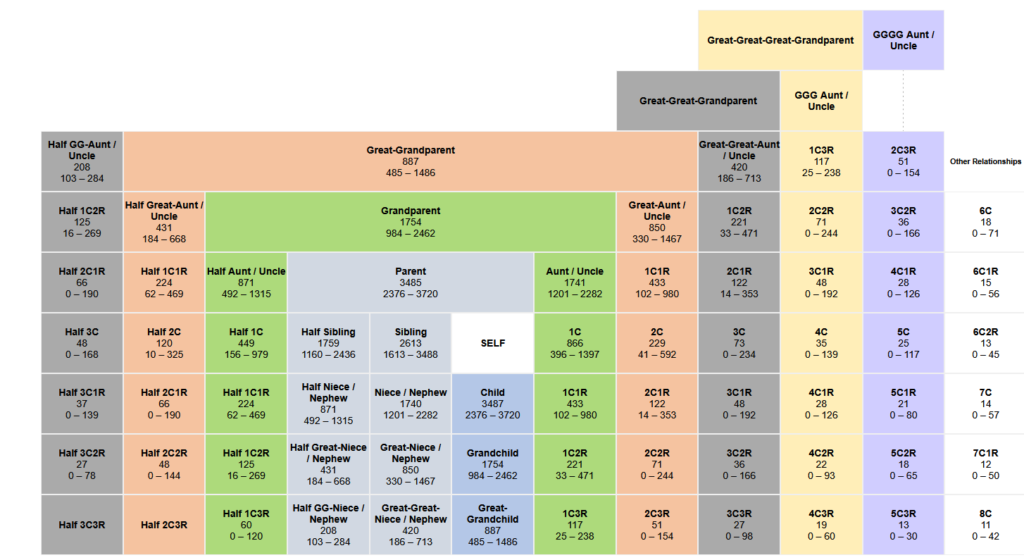
Adapted from: the shared cM project (www.dnapainter.com)
| Relationship | Average cM | Observed range |
|---|---|---|
| Parent / child | 3,485 | 2,376–3,720 |
| Full siblings | 2,613 | 1,613–3,488 |
| Grandparent / grandchild | 1,754 | 984–2,462 |
| Uncle-aunt / niece-nephew | 1,741 | 1,201–2,282 |
| First cousins | 866 | 396–1,397 |
| First cousins once removed | 433 | 102–980 |
| Second cousins | 229 | 41–592 |
| Third cousins | 73 | 0–234 |
| Fourth cousins | 35 | 0–139 |
Two caveats:
- Ranges overlap. A given amount of shared DNA usually fits several relationships, so the paper trail is always needed to decide which one is right.
- Endogamy inflates the numbers. In small communities where families intermarried for generations, as in many villages around Bergamo, two people can descend from the same ancestors along several lines and share more DNA than their closest known link would suggest.
Two Sirtoli DNA matches
Paolo and Cynthia: fourth cousins
In 2016 Paolo Sirtoli took a DNA test with the National Geographic kit. In 2018 Cynthia Savage of Kansas City (USA) also tested. The two had never met, but Family Tree DNA, where both results had been uploaded, flagged them as a match and suggested a distant relationship.
Once in touch, Paolo and Cynthia compared their family trees and found the link: both descend from Felice Sirtoli, born in 1819, whose grandson Giuseppe emigrated to the United States in 1905. Both are five generations from Felice, their 3x great-grandfather, which makes them fourth cousins (tenth degree under Italian law).
They share 59 cM. Fourth cousins share 35 cM on average, with a range of 0–139 cM, so the result is fully consistent with the family trees. It is worth being precise about what this shows: 59 cM would also fit other relationships, such as third cousins once removed, and many fourth cousins share no detectable DNA at all. The match supports the documented connection rather than proving it on its own. The strongest confirmation would come from other descendants of Felice, through different children, who share the same DNA segment with both Paolo and Cynthia (a method called triangulation).
Paolo and Valerio: seventh cousins once removed
Valerio Giannetta tested in 2017. In this case the relationship was known in advance from the records: the common ancestor is Bartolomeo Sirtoli, born in 1694, eight generations from Paolo and nine from Valerio. They are seventh cousins once removed (17th degree under Italian law).
They share 8.5 cM. At this distance, though, DNA can no longer confirm the link. The expected share between seventh cousins once removed is a tiny fraction of a centimorgan, and the vast majority of such pairs share nothing detectable. A single small segment, under about 10 cM, is often a false match or reflects common ancestry in the local population rather than descent from one specific couple. In an area where families intermarried for centuries, Paolo and Valerio’s 8.5 cM may well come from another, unknown common ancestor. Their connection through Bartolomeo rests on the documents, and those stand on their own.
Have you tested?
If you descend from the Sirtoli family and have taken a DNA test, please get in touch. Every new match helps confirm the family tree. A Y-DNA test would be especially useful: the Y chromosome passes from father to son along with the surname, so comparing male-line Sirtoli descendants can reveal whether the different Sirtoli branches share a common ancestor.